Range of services
In addition to treating general internal medicine conditions, we specialise in the following fields:
Gastroenterology and interventional endoscopy
Gastroenterology deals with all diseases of the oesophagus, stomach, small and large intestine, pancreas, gallbladder and bile ducts, and liver. Diagnosis is carried out using high-resolution endoscopic procedures, ultrasound and state-of-the-art radiological imaging (CT, MRI, scintigraphy). In addition to medication, we treat these diseases with a broad range of endoscopic-interventional, ultrasound-guided and radiologically guided therapeutic procedures.
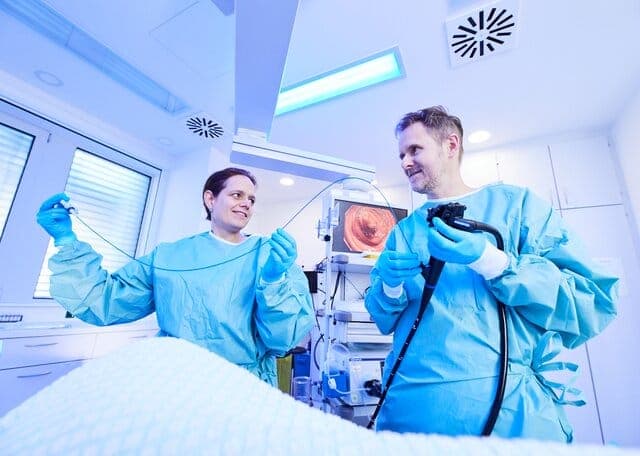
A particular focus of our department is the Centre for Interventional Endoscopy, equipped with the latest high-end devices. In addition to standard procedures such as gastroscopy and colonoscopy (oesophagogastroduodenoscopy (OGD) and ileocolonoscopy) and 24/7 emergency treatment, we offer numerous interventional techniques with the highest level of expertise:
- Chromoendoscopy and zoom endoscopy for the detailed diagnosis of tumours throughout the entire gastrointestinal tract
- Removal of polyps and early-stage cancer throughout the entire gastrointestinal tract by polypectomy, endoscopic mucosal resection (EMR), endoscopic submucosal dissection (ESD) or endoscopic full-thickness resection (EFTR)
- Treatment of bile duct and pancreatic diseases by endoscopic retrograde cholangiopancreatography (ERCP), bile duct endoscopy (cholangioscopy), percutaneous transhepatic cholangiodrainage (PTCD), endoscopic ultrasound-guided pseudocyst drainage with necrosectomy, and endoscopic ultrasound-guided transduodenal or transgastric biliary drainage
- Treatment of motility disorders of the oesophagus (achalasia) or stomach by peroral endoscopic myotomy (POEM)
- Treatment of a Zenker’s diverticulum by endoscopic septotomy (Zenker’s diverticulotomy)
- Treatment of strictures throughout the entire gastrointestinal tract by balloon dilatation, bougienage, stent placement or endoscopic ultrasound-guided gastroenterostomy
- Diagnosis and treatment of small bowel diseases by video capsule endoscopy and single-balloon enteroscopy
- Treatment of Barrett’s oesophagus or radiation-induced inflammation of the rectum (radiation proctitis) by endoscopic ablative procedures (argon plasma coagulation, hybrid argon plasma coagulation, radiofrequency ablation (BARRX)
- Placement of a feeding tube through the abdominal wall (percutaneous endoscopic gastrostomy (PEG))
- Ultrasound-guided drainage of fluid collections or abscesses in the abdomen
- Treatment of liver tumours by ultrasound-guided radiofrequency thermal ablation
- Detailed diagnosis of reflux disease and oesophageal motility disorders by pH monitoring (including the Bravo capsule), impedance measurement and manometry
- Diagnosis of lung diseases by bronchoscopy
Haematology and oncology
Haematology and oncology deal with changes in the blood-forming system and its malignant diseases, as well as tumours of the internal organs. For this purpose, our department offers the standard diagnostic methods such as ultrasound diagnostics, endoscopy, radiological imaging and laboratory procedures, as well as bone marrow aspiration.
Treatment follows current international standards, which are ensured by weekly interdisciplinary tumour boards, continuous professional development and, not least, many years of experience and our staff. In addition, we are a certified colorectal cancer centre and a member of the Tumorzentrum Freiburg.
Palliative medicine
The aim of palliative care is to provide comprehensive support to people with incurable illnesses and their relatives. The focus is on maintaining or restoring a high quality of life while respecting the patients’ self-determination. This includes, on the one hand, medical and nursing measures to relieve distressing physical symptoms such as pain, nausea or shortness of breath and, on the other hand, support with psychological, spiritual and social needs, with pastoral and psycho-oncological support also being offered. Ensuring comprehensive care after the hospital stay also plays a major role. The palliative care service consists of an interdisciplinary and multiprofessional team. Close cooperation between specially trained doctors, nurses, psycho-oncologists, chaplains, physiotherapists, social workers and discharge managers ensures holistic treatment for our patients.
Diabetology
In our clinic we offer diagnostics and all treatment options (with tablets, insulin including pump therapy and continuous glucose monitoring) for type 1, type 2 and type 3 diabetes. We can also provide advice and care for diabetic women before a planned pregnancy and during pregnancy. Our services further include the treatment of diabetic foot syndrome and interdisciplinary pre-, peri- and postoperative care during your inpatient stay. If you would like nutritional counselling or structured diabetes education, individual treatment plans and exercise plans can be drawn up in group or individual sessions. In addition, the Evangelisches Diakoniekrankenhaus offers various structured diabetes education programmes for type 2, education sessions for type 1 in cooperation with practices in private practice, and regular meetings of the quality circle of the Diabetesnetz Breisgau e.V.
Cardiology and angiology
To treat diseases of the heart and blood vessels, our department uses all modern methods of non-invasive cardiological diagnosis and treatment. This also includes cardiac ultrasound via the oesophagus (TEE) and the implantation of event recorders. In cooperation with the Institute of Radiology and Nuclear Medicine, CT, scintigraphy and PET examinations of the heart are also available. If treatment of the coronary arteries is necessary, this can be carried out promptly and without difficulty in the nearby catheter laboratories.
Last updated: